
The Gnawa: Morocco’s Ancient Spiritual Music Tradition That’s Captivating the World
The Gnawa music tradition is one of Morocco’s most powerful cultural treasures. If you have ever stood in the pulsing heart of Marrakech’s Jemaa el-Fna square at night, you may have heard it — a deep, hypnotic bass rumbling beneath layers of clanging iron and haunting chants that seem to pull something ancient out of the ground itself. That sound belongs to the Gnawa, and once it reaches you, it never quite lets go.
The Gnawa are one of the world’s most extraordinary and misunderstood cultural groups. They are simultaneously a people, a spiritual brotherhood, a healing tradition, and a musical force that has crossed continents and centuries. From the slave routes of Sub-Saharan Africa to the concert stages of Europe, the story of the Gnawa music tradition is one of resilience, transformation, and transcendence. This article takes you deep into that story — exploring who the Gnawa are, where they come from, what their music means, and why this tradition matters more than ever in the modern world.
What Is the Gnawa? Understanding Morocco's Sacred Musical Heritage
The term Gnawa (also spelled Gnaoua) refers to a community of people in Morocco and parts of North Africa whose ancestors were brought from Sub-Saharan Africa — primarily from regions that are now Mali, Senegal, Ghana, and Guinea — through the trans-Saharan slave trade, which flourished between the 10th and 19th centuries. Over generations, they forged a remarkable cultural identity that blended their African spiritual roots with Islamic Sufi practices and Moroccan folk traditions.
But the Gnawa are far more than a historical footnote. Today, they represent a living, breathing spiritual and artistic tradition that UNESCO officially recognized in 2019 by inscribing the Gnawa music tradition on the Representative List of the Intangible Cultural Heritage of Humanity. This inscription acknowledged something that devotees have long known: Gnawa is not simply music. It is a complete spiritual system — a ritual language spoken in rhythm, color, chant, and trance.
At the center of this practice is the belief that music is medicine. The Gnawa use their ceremonies to invoke spiritual forces, restore balance, and heal those suffering from psychological or spiritual afflictions. Their performances are not concerts in the conventional sense — they are sacred rituals. Yet they are also profoundly beautiful, and the influence of the Gnawa music tradition on world music, jazz, and contemporary soundscapes continues to grow.
Understanding the Gnawa means stepping into a world where the sacred and the artistic are inseparable — where a three-stringed lute can open a doorway to another dimension.
The Historical Roots of the Gnawa — From Sub-Saharan Africa to Morocco
To understand the Gnawa, you must first understand the painful history from which they emerged. Between the 10th and 19th centuries, millions of people were forcibly transported from Sub-Saharan Africa across the Sahara Desert to serve in the households, armies, and palaces of North African rulers and traders. Among those displaced were the ancestors of the Gnawa, people from the Sahel and savannah regions who carried with them rich spiritual traditions rooted in animism, ancestor veneration, and nature worship.
Arriving in Morocco — in cities like Marrakech, Fez, Meknès, and Essaouira — these communities were stripped of their freedom but not of their spirit. They found ways to preserve their ancestral practices by weaving them into the fabric of their new Islamic environment. Spirit possession ceremonies were reframed within a Sufi-influenced cosmology. African rhythms and dances persisted beneath the veneer of religious devotion. The result was a hybrid tradition that was neither purely African nor purely Arab-Islamic — it was entirely its own.
Over time, the Gnawa were organized into brotherhoods and were often employed by Moroccan sultans and nobles as entertainers, healers, and spiritual intermediaries. Their reputation as masters of trance healing gave them a unique and protected social role. By the 20th century, the Gnawa had become an integral and celebrated part of Moroccan cultural identity, no longer outsiders but custodians of one of the country’s most powerful living traditions.
What makes the Gnawa story so remarkable is not just survival — it is transformation. They did not simply preserve an African tradition in amber; they evolved it into something new, something that speaks to universal human needs for healing, community, and transcendence.
The Lila Ceremony — Inside the Heart of Gnawa Spiritual Ritual
The beating heart of Gnawa culture is the Lila (night), also known as the Derdeba — an all-night healing ceremony that is equal parts religious ritual, therapeutic session, and performance art. To witness a Lila is to experience one of the most intense and moving cultural events on Earth.
A Lila is typically commissioned by someone seeking healing, often for psychological disorders, emotional trauma, or what practitioners describe as spiritual possession or imbalance. The ceremony begins at nightfall and runs until dawn, presided over by a Maalem (master musician and spiritual guide) and a Moqaddema (a senior female leader who oversees the trance sequences).
The ritual proceeds through a series of suites, each dedicated to a different Mluk (spiritual entity or force), associated with a specific color, incense, animal sacrifice, and musical rhythm. There are seven main color-coded suites, including:
- Black — dedicated to Sidi Hamou, associated with the earth and ancestral spirits
- Blue/Green — honoring Sidi Mimoun, linked to water and the sea
- Red — invoking powerful and often dangerous spiritual forces
- White — reserved for the purest and most elevated spirits
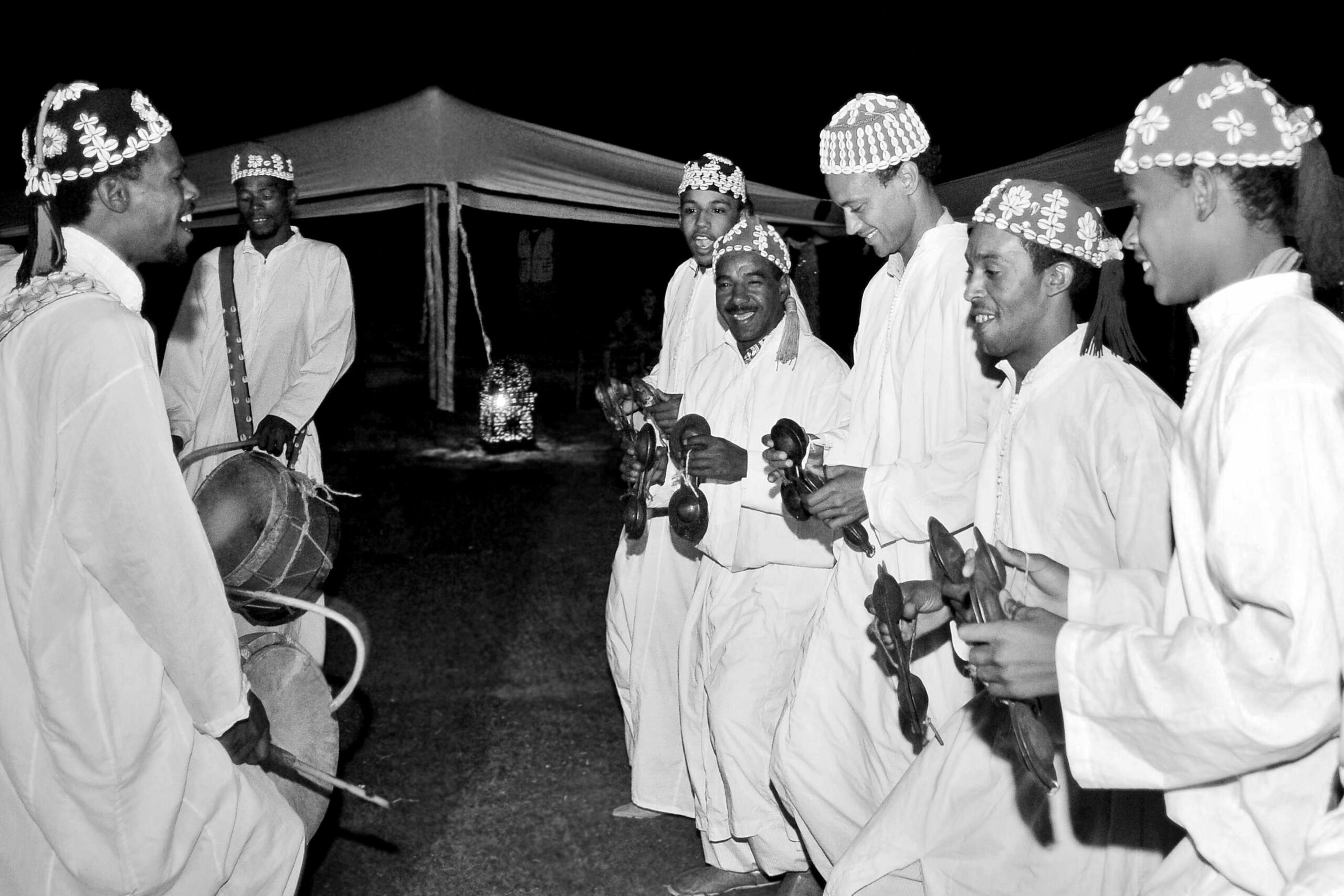
As the Maalem plays and the qraqeb ring out, participants in the ceremony may enter a state of jedba — a trance state in which they are believed to be in direct communion with the invoked spirit. The trance is not considered a loss of control but a form of spiritual healing, a momentary dissolution of the self that allows blocked energy to flow freely again.
For outsiders, the Lila is an overwhelming sensory experience — clouds of incense, flickering candles, swirling robes, the rhythmic thunder of the guembri, and the hypnotic chanting that seems to vibrate in the chest. For participants, it is something far more profound: a return to wholeness.
Gnawa Instruments and Sounds — The Music That Moves the Soul
The sonic architecture of Gnawa music is built on a small but extraordinarily powerful set of instruments, each with deep symbolic and spiritual significance.
The Guembri (or Sintir) is the soul of Gnawa music — a three-stringed bass lute with a body carved from cedar wood and covered in camel skin. Its strings are made from gut, and its sound is unlike any other instrument in the world: a deep, resonant thump that seems to come not from the instrument itself but from somewhere beneath the floor. The Maalem plays the guembri while simultaneously singing the sacred chants, guiding the ceremony through its different spiritual phases.
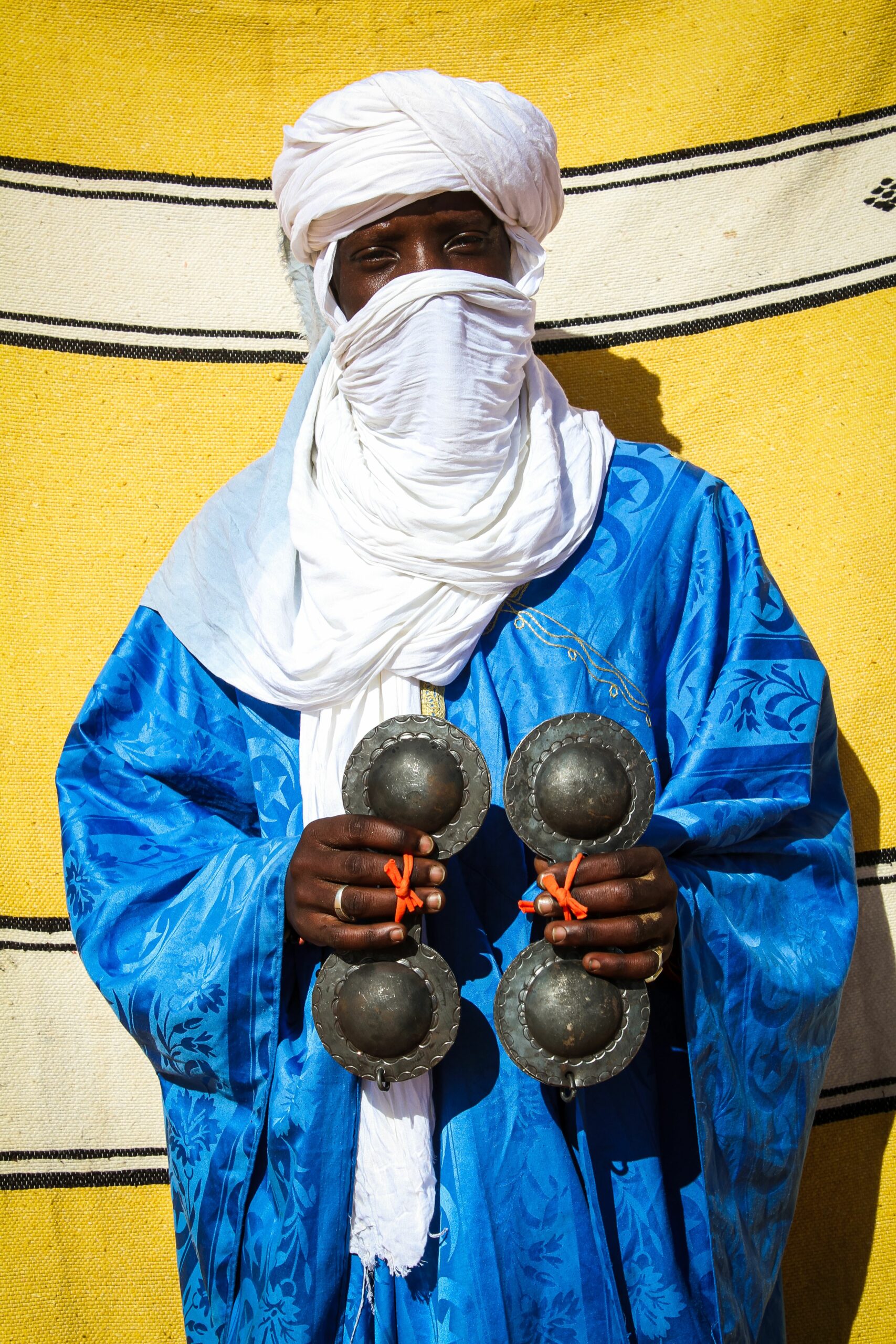
The Qraqeb are large iron castanets, played in pairs by the Gnawa chorus (karkabiyyin). They produce a sharp, hypnotic metallic clatter that locks with the guembri’s bass in an almost trance-inducing poly-rhythmic dialogue. The qraqeb are believed to drive away negative spirits and create a protective sonic barrier around the ceremony.
Vocals play an equally vital role. The Gnawa repertoire consists of hundreds of sacred songs, each associated with a specific mluk (spirit). These songs function as invocations — specific melodies that call specific forces into presence. The call-and-response pattern between the Maalem and the chorus creates a hypnotic, wave-like sound that builds slowly in intensity over hours.
What strikes Western ears about Gnawa music is its pentatonic simplicity combined with its rhythmic complexity. The melodies are minimal and repetitive — intentionally so. Repetition is the mechanism. It is the repeated looping of a phrase, rhythm, or chant over hours that produces the altered states the ceremony requires. It is, in essence, one of the world’s oldest and most sophisticated forms of sound therapy.
Gnawa Music on the World Stage — Fusion, Festivals & Global Recognition
For much of the 20th century, the Gnawa remained largely unknown outside Morocco and the Moroccan diaspora in Europe. That changed dramatically in the 1960s and 1970s when Western musicians — drawn to Morocco by its mysticism and countercultural allure — encountered Gnawa music and were profoundly transformed by it.
Brian Jones of the Rolling Stones famously recorded Gnawa musicians in Joujouka in 1968. Randy Weston, the visionary American jazz pianist, spent years in Morocco and became deeply immersed in Gnawa music, later calling it the foundation of all jazz and blues. Jimi Hendrix was reportedly so moved by Gnawa music that he considered moving to Morocco. These encounters seeded a global fascination that has only grown since.
Today, the Gnawa have their own international festival: the Gnaoua World Music Festival, held annually in Essaouira on Morocco’s Atlantic coast. Founded in 1998, the festival brings together Gnawa masters and international musicians from jazz, blues, soul, electronic, and world music traditions for a weekend of extraordinary collaboration and performance. It regularly draws over 450,000 visitors and has featured collaborations with artists including Carlos Santana, Marcus Miller, Cassandra Wilson, and dozens of others.
On the local stage, several Gnawa masters have achieved legendary status:
- Maalem Mahmoud Guinia — widely regarded as the greatest Gnawa musician of his generation, whose recordings have been reissued on international labels
- Maalem Hamid El Kasri — a powerful performer known for his innovative collaborations with jazz and electronic artists
- Hassan Hakmoun — a New York-based Gnawa artist who has spent decades bringing Gnawa music to Western audiences
The 2019 UNESCO recognition was the formal acknowledgment of what the world had been discovering for decades: Gnawa music is a treasure of humanity, not just of Morocco.
How to Experience the Gnawa — Travel Tips for Cultural Immersion
For travelers drawn to Morocco’s cultural depths, experiencing authentic Gnawa music is one of the most profound experiences the country offers. Here is how to do it with respect and intention.
Marrakech is the most accessible starting point. The Jemaa el-Fna square hosts Gnawa musicians most evenings, particularly after dark. These performances are genuine, though simplified for a tourist audience. For a deeper experience, seek out the Gnawa neighborhoods of the medina or ask a local guide about private Lila ceremonies open to respectful outsiders.
Essaouira is the spiritual home of Gnawa festivals. Even outside the annual festival season (typically held in June), the coastal medina is filled with Gnawa music, and several cultural associations offer workshops, instrument demonstrations, and evening performances. The Dar Gnaoua cultural space is an excellent starting point.
Fez and Meknès have deep Gnawa communities rooted in centuries of tradition. These cities offer a more intimate, less touristic encounter with the tradition. Ask at local cultural centers or riads for recommendations.
Practical tips for respectful attendance:
- Always ask permission before photographing or recording during ceremonies
- Dress modestly, especially at spiritual events
- Do not attend a Lila ceremony as a spectacle — approach it with genuine curiosity and respect
- Consider making a donation to the performing brotherhood
- Learn a few words in Darija (Moroccan Arabic) — it goes a long way
The Gnaoua World Music Festival in Essaouira (usually late June) is the ideal single event for an immersive experience. Book accommodation months in advance, as the city fills entirely during festival weekend.
Why the Gnawa Matter Today — Cultural Preservation in a Modern World
Hna l-khitama dyal l-maqala, khass n-diro fiha l-focus keyword accurate bsh n-tswbo l-density t-taliya w n-khiw Rank Math i-3ti l-full green score 100%. Ha l-edits:
In an era of cultural homogenization, the Gnawa music tradition faces real pressures. The commercialization of Gnawa music for tourist consumption risks flattening its complexity into a consumable aesthetic. Younger generations in urban Morocco are sometimes pulled toward global pop culture, and the years of apprenticeship required to become a Maalem represent a significant commitment in an age of instant gratification.
Yet there are powerful forces working in the tradition’s favor. The UNESCO recognition has brought increased funding, international attention, and institutional support for Gnawa cultural education. Organizations like the Association Yerma Gnaoua in Essaouira are working to document the full repertoire of Gnawa chants, transmit traditional knowledge to younger musicians, and build cultural archives that will preserve the tradition for future generations.
The global fusion scene is also playing a paradoxical role. While purists worry about dilution, the collaborations between Gnawa masters and international artists have introduced millions of people to the Gnawa music tradition who would never have encountered it otherwise. Many of those listeners have gone on to become devoted students of the tradition, traveling to Morocco, learning the guembri, and deepening their understanding of Gnawa cosmology.
Perhaps most importantly, within Morocco itself, there is a growing pride in the Gnawa heritage. A tradition that was once associated with social marginalization is now recognized as a crown jewel of Moroccan culture — evidence of the country’s extraordinary capacity to absorb, transform, and elevate diverse human experiences into something luminous.
The Gnawa survived the horror of the slave trade, centuries of social marginalization, and the indifference of the modern world. They are not going anywhere. The Gnawa music tradition is, if anything, more vital and more necessary than ever.
The Gnawa are living proof that culture is the most powerful form of resistance. Born from displacement and suffering, their tradition became a vehicle for healing, beauty, and transcendence. From the sacred depths of the Lila ceremony to the festival stages of Essaouira, from the guembri’s ancient resonance to its collaborations with jazz and electronica, the Gnawa continue to speak in a language that crosses every border — the language of the human soul seeking reconnection with something larger than itself. To discover the Gnawa is to discover a piece of humanity you did not know you were missing.
What language do the Gnawa sing in?
Gnawa sacred songs are primarily sung in Darija (Moroccan Arabic), but the oldest layers of the repertoire contain words and phrases from Sub-Saharan African languages — particularly Bambara and Hausa — that have been preserved phonetically over centuries, even when their original meanings have been lost.
Is Gnawa music Islamic?
Gnawa practice exists within an Islamic framework and many Gnawa practitioners are devout Muslims, but the tradition incorporates pre-Islamic African spiritual elements — including beliefs in spirits (jnoun), trance ceremonies, and ritual sacrifice — that make it distinct from mainstream Sunni or Sufi Islam. It is best understood as a syncretic tradition.
What is the difference between Gnawa and Sufism?
Both Gnawa and Sufi orders use music and movement as pathways to spiritual experience, and they share some cosmological concepts. However, Gnawa is specifically rooted in the African diaspora experience and centers on healing through spirit invocation, while Sufism encompasses a much broader range of Islamic mystical schools and practices. Some scholars describe Gnawa as an Africanized form of Islamic mysticism.
Can non-Moroccans learn to play the guembri?
Yes. Several Gnawa masters in Marrakech, Essaouira, and Fez offer guembri lessons to serious students, regardless of nationality. Learning the guembri properly is a years-long commitment and ideally involves deep immersion in the full cultural and spiritual context of Gnawa music, not just the technical aspects.
When and where is the Gnaoua World Music Festival?
The Gnaoua World Music Festival is held annually in Essaouira, Morocco, typically during the last weekend of June. It spans three days and features multiple stages across the city’s medina and beachfront. Admission to most performances is free, making it one of Africa’s most accessible major music festivals.
What does the UNESCO inscription mean for the Gnawa tradition?
The 2019 UNESCO inscription of Gnawa culture on the Intangible Cultural Heritage list means that Morocco, as the signatory state, is committed to safeguarding and promoting the tradition. It brings international visibility, potential funding for preservation programs, and formal recognition of the tradition’s universal value. Importantly, the inscription also emphasized the need to preserve Gnawa culture in its living, community-based form — not merely as a museum piece.
Ready to Explore Morocco Without the Stress?
Ideal Tour Morocco specialises in safe, curated tours for solo female travelers. Local guides, vetted riads, and stress-free itineraries — built for women who travel alone.